

Invicta Orient Mako II Review – Real User Experience & Performance Analysis
The Invicta Orient Mako II (Model: FAA02001B9) has built a strong reputation as one of the most talked-about entry-level automatic dive watches on the market. Priced typically under $200 – and often closer to $125 – $150 – it promises Japanese automatic movement, stainless steel construction, 200m water resistance, and classic dive aesthetics without luxury pricing. On paper, that value proposition is hard to ignore. In real-world use, however, the experience is more nuanced. Some owners describe it as an unbeatable bargain and even call it a “Seiko SKX killer,” while others report accuracy concerns, crown issues, and disappointing customer support. This review analyzes real feedback to separate marketing perception from everyday reality.
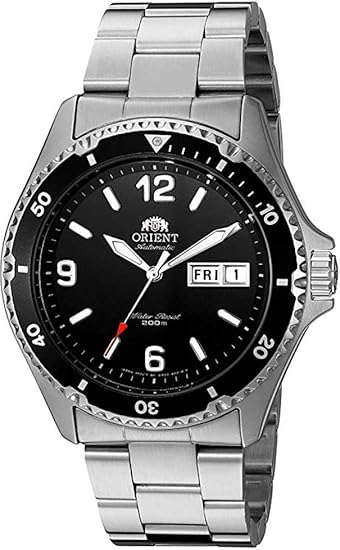
At first impression, the watch delivers a strong visual appeal. The stainless steel case feels solid, with noticeable weight that avoids the hollow, inexpensive feel found in many fashion watches. The dial is clean, legible, and well-proportioned. The applied indices and hands provide good contrast against the black dial variant, making it easy to read at a glance. The bezel action, according to many users, feels precise, although the grip can be slightly smooth and harder to turn compared to more aggressively knurled bezels. The bracelet has a reassuring metal construction and sits comfortably on the wrist, though some users mention occasional rattling and a slightly lighter weight than expected. Overall finishing is impressive for a budget automatic dive watch, especially considering the price bracket.
Under the caseback sits Orient’s in-house automatic movement, which is a major selling point. Unlike many competitors at this price that rely on outsourced movements, Orient manufactures its own calibers. In ideal conditions, the watch is rated at +25/-15 seconds per day. Some users report excellent accuracy—gaining only 3 seconds per day, outperforming significantly more expensive Swiss models. Others, however, experience gains of 15–20 seconds per day or even up to 2 minutes per week, which technically falls within factory tolerances but may feel unacceptable for daily wear. The power reserve averages around 25–40 hours, depending on activity level, with several users noting it closer to 25 hours in practice. For someone wearing it daily, this may not be an issue, but those rotating watches might need frequent resetting.
Invicta Orient Mako II Design, Build Quality & Wearability
From a design standpoint, the Orient Mako II FAA02001B9 leans toward traditional dive watch aesthetics rather than flashy or oversized trends. The case diameter is moderate, making it wearable for most wrists, though some buyers advise checking measurements before purchase. It doesn’t wear excessively large, and its balanced proportions give it a refined, versatile presence that transitions easily from outdoor activities to casual office settings. Many owners appreciate that it looks significantly better in person than in product photos.
The bezel alignment and dial finishing receive generally positive remarks. However, lume performance is inconsistent. Some users report that the luminous markers fade quickly after initial brightness, even after prolonged light exposure. While acceptable for occasional nighttime checks, it may not satisfy those expecting strong all-night legibility. This is an area where higher-tier dive watches tend to outperform budget models.
The screw-down crown is one of the most criticized aspects. Several users report difficulty threading it back in, requiring fingernails and careful handling. In a dive watch, crown functionality is critical because it protects against water intrusion. There are documented cases of condensation forming under the crystal after swimming, raising concerns about sealing reliability. Although not universally reported, the crown design appears to be a weak point in an otherwise sturdy construction.
Spring bars have also been mentioned as bending under stress, particularly when used with the original steel bracelet. While replacements were provided in some cases, this raises questions about quality control consistency. Over-extended ownership—two to five years—some users report mechanical drift, significant time loss, or even internal dial misalignment, including a rare case where the dial rotated inside the case. These issues are not universal but indicate variability in long-term durability.
Invicta Orient Mako II Accuracy, Reliability & Ownership Experience
Accuracy is where opinions sharply diverge. Some owners praise the watch as extraordinarily precise for its price, comparing it favorably to much more expensive models from brands like Tag Heuer and Omega. Reports of +3 seconds per day are impressive and demonstrate the movement’s potential when properly regulated. On the other hand, some users experience gains of 2–3 minutes per day, requiring frequent time corrections. While these numbers may technically remain within factory tolerance standards, they undermine confidence for wearers who depend on precise timekeeping.
Customer service experiences also vary. Some buyers received prompt responses and replacement parts, while others describe slow turnaround times, pressure testing fees, extended 6–8 week repair timelines, or minimal communication. Warranty clarity has been another issue, especially for purchases made through warehouse deals or third-party sellers. Buyers expecting seamless support comparable to higher-end brands may be disappointed.
Manufacturing origin has also been confused. Although marketed as a Japanese brand and part of the Seiko Epson group, some documentation suggests that it is assembled in China. This does not automatically imply low quality – many reputable brands assemble globally – but transparency is particularly important to buyers who specifically seek “Made in Japan” labeling.
Despite these criticisms, many enthusiasts still strongly recommend the watch. For under $150, few automatic dive watches offer comparable specifications, in-house movement, and aesthetic refinement. It provides an accessible entry point into mechanical watches, especially for those transitioning from quartz or fashion brands. The absence of heavy marketing spending—unlike brands such as Rolex—helps keep pricing competitive, but it also means fewer luxury retail touchpoints and possibly leaner after-sales infrastructure.
Good Features of Invicta Orient Mako II
- Excellent value for money under $200
- In-house Japanese automatic movement
- Solid stainless steel construction
- 200m water resistance
- Clean, legible dial design
- Balanced case size for most wrists
- Strong reputation among entry-level collectors
- Attractive alternative to overpriced fashion watches
- Some units demonstrate outstanding accuracy
Bad Features of Invicta Orient Mako II
- Accuracy inconsistency between units
- A screw-down crown can be difficult to operate
- Lume fades quickly in some cases
- The bracelet may rattle slightly
- Spring bars reported bending in some units
- Customer service experiences vary widely
- Power reserve is sometimes closer to 25 hours
- Occasional long-term durability complaints
Final Thoughts
The Invicta Orient Mako II remains one of the most compelling budget automatic dive watches available, but it is not flawless. When you receive a well-regulated unit, it can outperform expectations and rival far more expensive watches in daily wear satisfaction. However, quality control variation and mixed service experiences mean ownership can be unpredictable. If your priority is maximum value and you understand the acceptable tolerance range of mechanical watches, this model offers strong appeal. If you require near-quartz precision, flawless crown mechanics, and premium after-sales service, you may need to invest more.
Overall Rating: 3.8 / 5
A strong value contender with real strengths—but also real compromises.